Hard cut
New shotA sudden change that lasts. Both models recognise the boundary.
Boundary score
True transitionPERSISTCue-only baseline
BMVC 2026
1 Computer Vision Lab, TU Wien
2 Institute of Creative\Media/Technologies, St. Pölten University of Applied Sciences
3 Ludwig Boltzmann Institute for Digital History
The difference is in what follows
A sudden change that lasts. Both models recognise the boundary.
One shot gives way to another. The change unfolds over several frames.
The camera moves, but the shot continues. PERSIST keeps the score low.
The light changes briefly. The scene returns without a new shot.
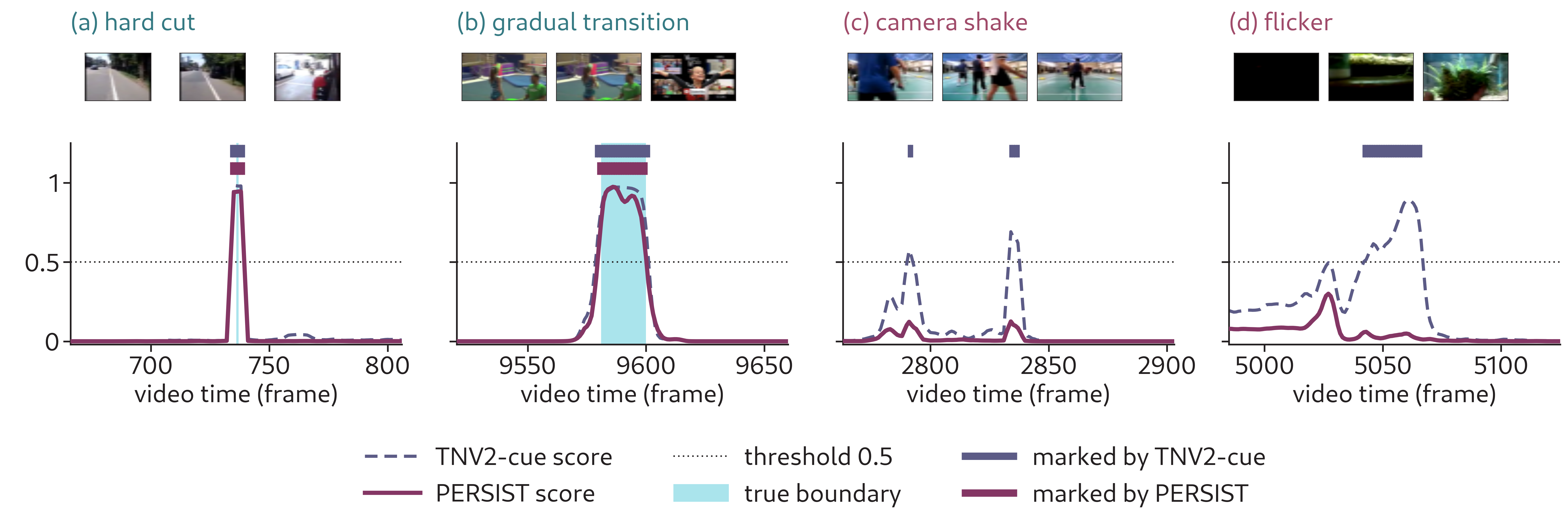
Real clips with recorded frame scores. The cue-only baseline uses the same backbone and training setup. Original figure ↗
How it works
Local change provides evidence. A continuous latent state helps distinguish lasting transitions from changes that soon return.
During training, PERSIST learns whether a visual change lasts or the video returns to its earlier appearance. This helps it distinguish new shots from brief disturbances.
Evaluation
The model learns to separate transient disturbances from real cuts, while remaining competitive across four video domains.
Published F1 at a shared threshold of 0.5.
| Method | ClipShots | BBC | AutoShot | HIST-GST12 |
|---|---|---|---|---|
| Pixel difference | 0.0351 | 0.0074 | 0.0683 | 0.0000 |
| HSV histogram | 0.5737 | 0.7786 | 0.6792 | 0.1544 |
| Edge change ratio | 0.3510 | 0.5552 | 0.3505 | 0.6019 |
| DeepSBD · AlexNet | 0.6843 | 0.8202 | 0.7539 | 0.8535 |
| DeepSBD · ResNet18 | 0.7555 | 0.8622 | 0.7303 | 0.8611 |
| TransNetV2 | 0.7793 | 0.9611 | 0.7993 | 0.9204 |
| PERSIST | 0.8023 | 0.9700 | 0.7953 | 0.9264 |
Real cuts remain; pseudo-events are suppressed.
A closer look
Compare the detections, then follow the evidence through two video examples.
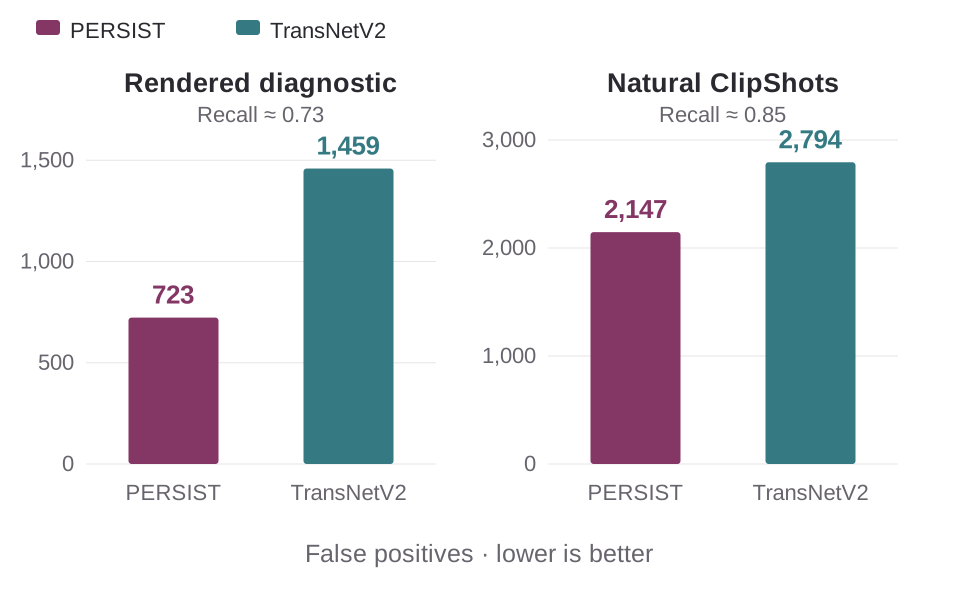
Equal sensitivity
Keeping sensitivity to real transitions exposes the difference in false detections.
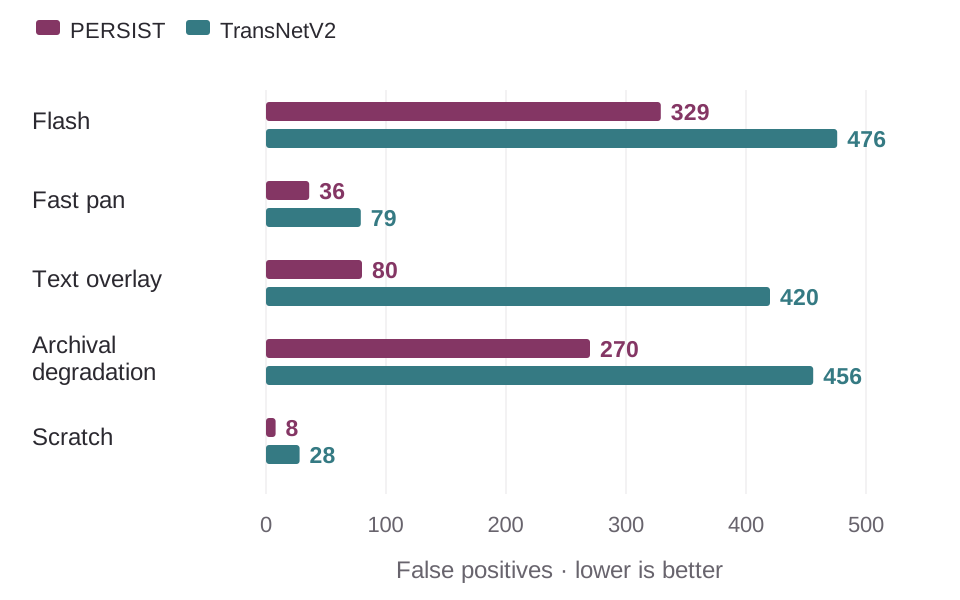
Across failure modes
The reduction spans flashing light, rapid camera motion, overlays and damaged film.
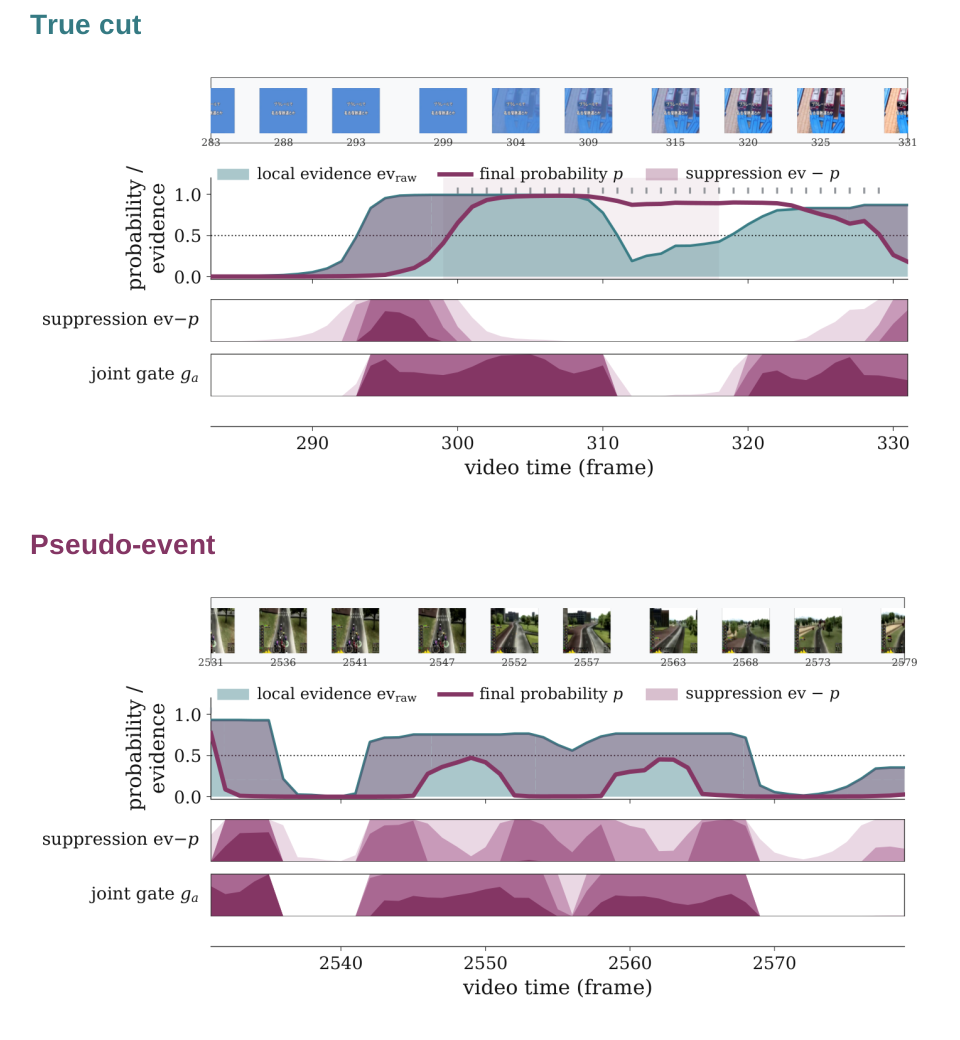
Frame by frame
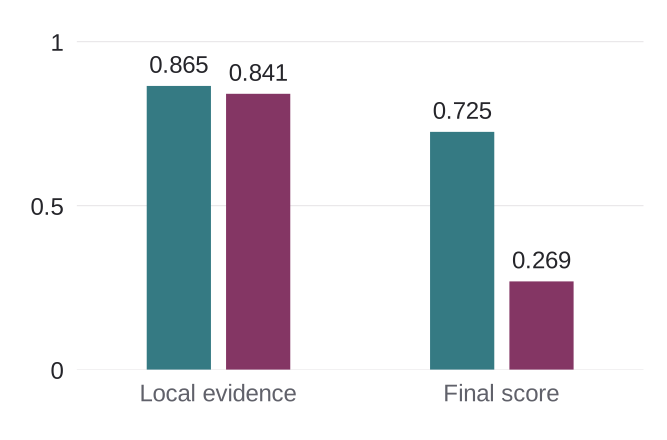
Read the footage alongside the model’s local evidence and final score.
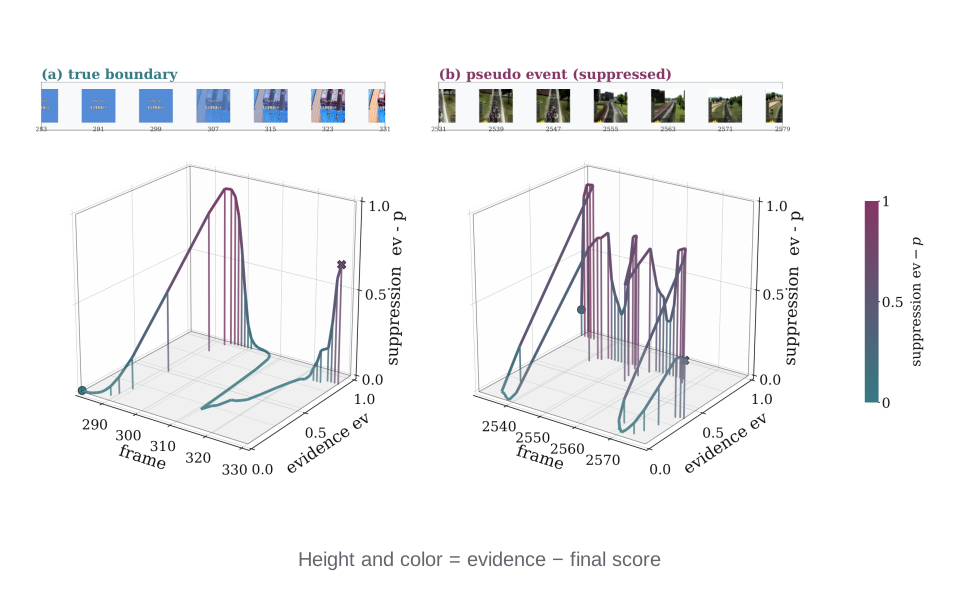
A geometric view
Track the gap between local evidence and the final score through both examples.
Citation
@inproceedings{lin2026persist,
  author    = {Lin, Tingyu and Stippel, Christian and Dadras, Armin and
               Zenzmaier, Jakob and Kleber, Florian and Aigner, Wolfgang and
               Sablatnig, Robert},
  title     = {{PERSIST}: Persistent-State Discrimination for Shot Boundary Detection},
  booktitle = {Proceedings of the British Machine Vision Conference (BMVC)},
  year      = {2026}
}
Questions about the work? Contact Tingyu Lin.